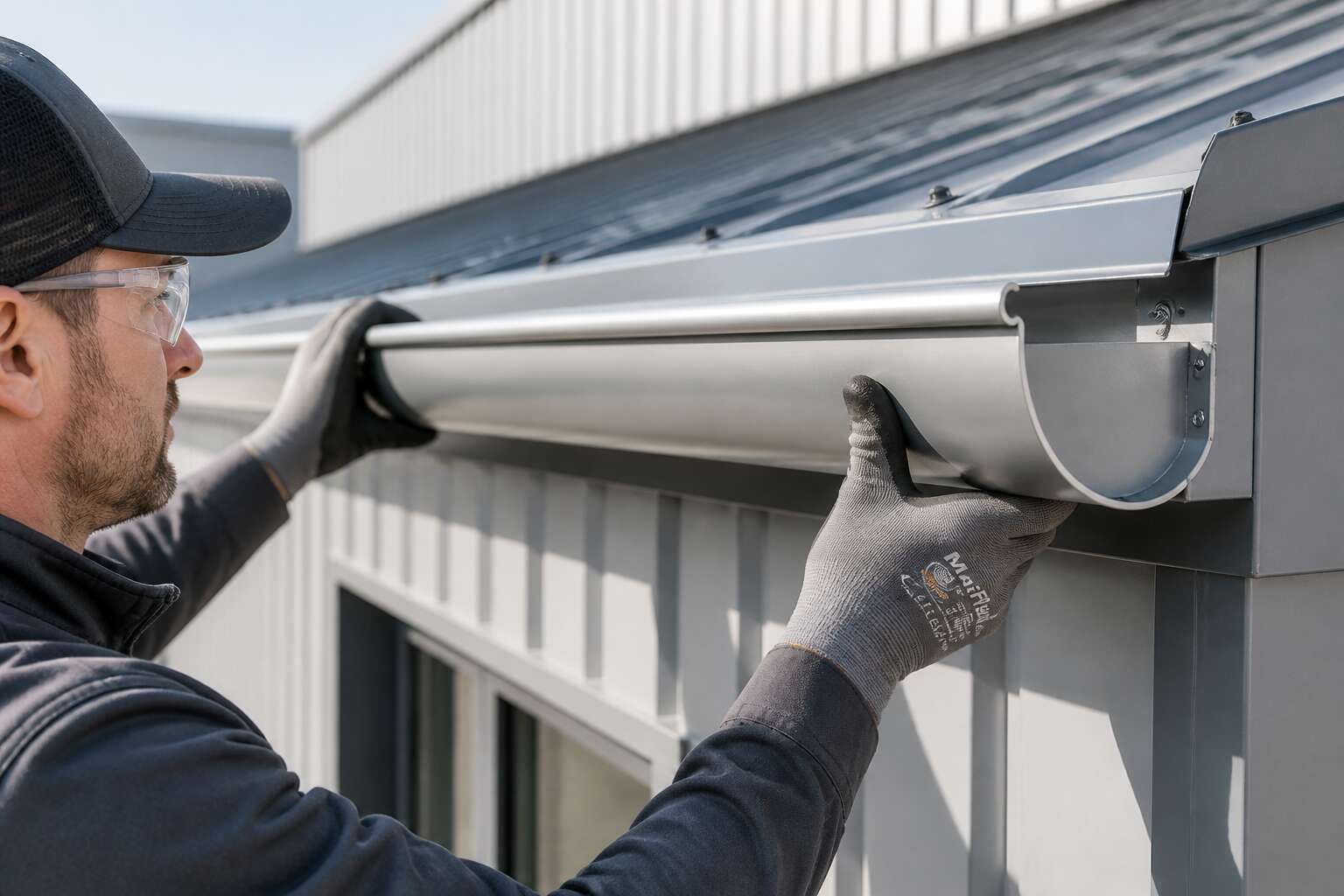
Understanding Factory Gutter Replacement
Signs Your Gutters Need More Than Repairs
Understanding Factory Gutter Replacement: Signs Your Gutters Need More Than Repairs
A single compromised gutter can channel thousands of litres of stormwater into your foundations during a Highveld summer. Most homeowners reach for sealant or replacement brackets when they spot a leak. In my experience, those repairs fail within a season or two.
Signs your gutters need more than repairs are visible before catastrophic failure. Look for rust that crumbles to the touch, seams that separate under light pressure, or a gutter line that dips noticeably between fixings. These indicate the metal has fatigued beyond its service life.
When you see the following, a factory gutter replacement is the right response:
- Downpipes that pull away from the wall despite repeated reattachment.
- Profiles that have warped or twisted after prolonged sun exposure.
- Internal corrosion that has thinned the metal to the point of fragility.
Each failure forces stormwater where it does not belong, undermining the structure the system is meant to protect.
How Factory-Fabricated Gutters Differ from Custom On-Site Systems
Factory fabricated gutters are formed under controlled conditions using roll forming machines. Custom on-site systems are bent by hand or portable machines, introducing variability. The factory process yields consistent profiles, precise angles, and uniform metal thickness. On-site fabrication depends on installer skill and the weather on the day. A factory gutter replacement offers precision that field bending cannot replicate.
- Factory seams are welded or joined with precision fittings; on-site seams rely on sealant and overlap.
- The factory finish is baked on, resisting UV damage better than site applied paint.
- Machine formed profiles maintain shape during installation, while hand bent sections can distort.
These differences matter on Highveld homes where hail and intense sun test every joint. A factory gutter replacement arrives as a complete, engineered component. The on-site method demands improvisation at the roofline, often creating weak points within a few seasons. The factory process removes the human error variable.
Evaluating Your Current Gutter System and Drainage Needs
One summer storm on the Highveld can dump thousands of litres onto a roofline in minutes! When I evaluate a property for a factory gutter replacement, I begin by measuring what the roof sheds. A 200 square metre roof collecting 25mm of rain produces roughly 5,000 litres. The drainage network must move that volume without pooling at the foundations.
Walk your property after heavy rain. Watch where water exits the roofline and where it settles. The number of downpipes, their placement, and the fall of each channel determine capacity. A factory gutter replacement will not fix a system that was undersized from the beginning.
- Gutter width and downpipe diameter.
- Slope toward each outlet.
- Overflow points during downpours.
Sediment and leaf debris upstream narrow the effective cross section, so inspect the entire pathway, not just the visible spans.
Common Misconceptions About Replacement Timelines
The biggest misconception about a factory gutter replacement is the timeline. Homeowners assume a crew can rip out the old steel and hang new channels in a single afternoon. It does not work that way. We measure, fabricate, deliver, and install. Each step follows the previous one, and the sequence takes days, not hours.
Replacement timelines depend on several factors:
- The total roofline length and the number of storeys
- Access around the property boundaries
- Whether the fascia boards need repair before mounting brackets go up
A factory gutter replacement scheduled for winter competes with afternoon thunderstorms on the Highveld. Sealants need dry weather to cure properly, and wet steel is dangerous to work on. The most reliable window is late spring, when the first summer storm can test the entire drainage system while the warranty is still fresh.
Key Benefits of Upgrading to Seamless Gutters
Enhanced Durability and Leak Resistance
One heavy summer downpour in Johannesburg can push more water down your gutters than a week of gentle drizzle. Yet many houses still rely on sectional gutters with joints that fail over time. Seamless alternatives offer a clear upgrade!
When you choose a factory gutter replacement, the run is formed continuously on site. No seams means fewer places for corrosion to start. Aluminium or steel retains its integrity for much longer.
- Joint failures vanish
- Alignment mistakes disappear
- Corrosion hotspots reduce dramatically
That is durability designed in from the start. Your drainage system becomes a single, reliable path for stormwater, built to handle the next heavy rain.
Improved Curb Appeal with Custom Profiles and Finishes
There is a quiet judgment in how a street evaluates a house. Neighbours notice the roofline before they notice the garden. A factory gutter replacement delivers profiles and finishes that make a home look deliberate, not merely maintained. Custom colours match the trim or the roof sheeting. The continuous line removes the staggered effect that sectional gutters develop over time. It is a subtle correction to the building’s proportions.
- Select from charcoal, ivory, bronze, or a shade matched to existing paintwork
- Choose a profile that suits your fascia depth and roof pitch
That visual coherence is part of why a factory gutter replacement holds value. The front elevation reads cleaner. The roofline sits crisper. And the neighbours, naturally, notice.
Lower Maintenance Requirements for Busy Homeowners
Few homeowners list “climbing the ladder to scoop decomposing leaves” as their favourite recreation. A factory gutter replacement with seamless profiles changes the maintenance math entirely.
Sectional gutters trap leaves and silt at every joint. Each connection is also a potential leak point, which means seasonal inspections, sealant touch-ups, and the occasional surprise waterfall. Seamless systems erase most of those joints, so water flows without nagging interruptions.
- No per-joint cleaning marathons
- Reduced risk of blocked downpipes
- Less time staring at your roof, more time ignoring it
For busy owners, the benefit is straightforward: the gutter becomes background furniture, not a recurring project.
Protecting Your Foundation and Landscape from Water Damage
The average suburban roof sheds enough rain in one storm to fill a small swimming pool. Where that water lands is the problem. Sectional gutters leak at every connection, sending water down the exterior wall instead of into the downpipe. The soil absorbs it. The foundation suffers. The garden turns to mud.
A factory gutter replacement with seamless profiles eliminates those leak points. Water travels the full length of the roofline with nowhere to escape. It reaches the downpipes, hits the drain, and disappears underground. The foundation stays dry. The lawn keeps its shape. The flower beds keep their soil.
That is the quiet job of a good gutter. It does not glisten or impress. It simply refuses to let water win.
The Installation Process Explained
Initial Site Evaluation and Downspout Assessment
A South African thunderstorm can send over a thousand litres of water off a modest roof in minutes. That water needs a proper escape route, so we start any factory gutter replacement with a site evaluation. We walk the entire roofline, measuring fascia angles and noting where water pools. A proper evaluation reveals hidden issues like inadequate pitch or damaged fascia boards before they disrupt the new installation.
Next comes the downspout assessment. We examine the placement and capacity of existing downspouts, often finding them undersized or poorly positioned for the roof’s surface area. In many South African homes, a single downspout handles too much runoff. We check for blocked bends, missing splash blocks, and outlets discharging against the foundation wall.
The information gathered during these steps directly informs how we structure your factory gutter replacement. Small adjustments here prevent major headaches later!
Precision Measurement and On-Site Fabrication
Precision measurement starts with laser levels and string lines to map the roofline’s true geometry. Each fascia board receives a mark that accounts for thermal expansion and the weight of water during a Highveld downpour. Small errors at this stage become permanent gaps later.
On-site fabrication follows. We roll the gutter profiles to exact lengths, removing seams and joins that fail over time. We cut mitres at corners and test each joint with water before permanent fixing. A millimetre of play here invites leaks within a season.
- Measure twice
- Cut once
- Test every seam
This process ends with a factory gutter replacement that fits securely and sheds water reliably.
Safe Removal of Old Gutters and Debris
Old gutters collect the sediment of decades. Leaves, silt, and the occasional bird skeleton. Removing them is an excavation. We strip the fascia bare, prying each section loose without disturbing the roofline. Safety demands a method. Ladders, harnesses, and a clear path below.
- Isolate the power supply near the roofline.
- Remove downpipes first to release trapped water.
- Lower each segment by hand, never drop.
This careful demolition prevents damage to your masonry and garden. Then we clear all debris from the work area. A clean surface ensures the factory gutter replacement seats properly.
Securing the Gutters with Proper Hanger Spacing
The installation process begins with a single fastener. Proper hanger spacing decides whether a gutter system survives the first heavy storm. For factory gutter replacement, this step is often overlooked, yet it determines the structural integrity of the entire run.
In South Africa, where rainfall can be sudden and intense, I follow a strict protocol. Hangers must sit close enough to distribute the load, yet far enough to permit thermal expansion. I measure each interval from the downspout, not from the corner.
- Steel profiles: every 900 millimetres in sheltered areas.
- Aluminium profiles: every 600 millimetres in exposed coastal winds.
- Always secure into the rafter tails, not the fascia board’s face.
I tension each screw to the same resistance. This uniformity prevents the metal from oil-canning, a subtle distortion that ruins the sightline of a flawless run. When the hangers are correctly placed, the gutter remains straight and true for years. That is the mark of a factory gutter replacement done without compromise.
Sealing Joints, Testing Water Flow, and Final Cleanup
Every factory gutter replacement hinges on sealed joints. A single pinhole can undermine an entire run. I warm the sealant to match ambient temperature, allowing it to flow into every crevice. Each overlap receives a full bead, then a tooled finish that presses the sealant deep into the seam.
Testing water flow follows immediately. I flood each downspout with a garden hose and observe the water’s behaviour across the entire run.
- Check for standing pools near the hangers.
- Listen for dripping at the sealed corners.
- Note any spray escaping the lip during heavy flow.
Then comes final cleanup. I remove every scrap of cutting debris, old sealant residue, and metal shavings that could stain the finish or clog the downpipes. The site is left clean enough to walk barefoot. That is the signature of a factory gutter replacement done with care.
Material and Cost Considerations
Aluminum vs. Steel vs. Copper: Choosing the Right Material
Material choice drives the final invoice more than any other variable in a factory gutter replacement. In South Africa, the difference between aluminum and copper can exceed threefold. The honest conversation begins with your budget and the architectural character of your home.
Aluminum offers a moderate price point and consistent performance. Steel sits on the lower end, but its weight demands sturdy brackets. Copper, an investment in permanence, commands a premium that some homeowners find worthwhile for heritage properties.
Think about the local climate and the building’s roofline. A coastal cottage may favor aluminum. A Victorian restoration nearly calls for copper. The factory gutter replacement should respect both the structure and the pocketbook, because the cheapest option today rarely becomes the cheapest option over two decades.
Custom Color Matching and Paint Adhesion
A factory gutter replacement rarely ends at the first coat of paint. The true cost of a seamless system often hides in custom color matching and proper paint adhesion, especially under South Africa’s intense UV exposure. Powder coating offers durability, but only when the substrate is cleaned and primed correctly. Steel gutters demand a zinc-rich primer. Aluminum needs an etch primer to hold the topcoat. Copper should never be painted, as its natural patina protects the metal.
- Confirm the manufacturer’s finish warranty before choosing a custom color.
- Ask about a two-coat system versus a single coat for severe climates.
- Verify that the factory gutter replacement includes touch-up kits for future scratches.
Paint adhesion fails when surface preparation is rushed. Coastal salt, airborne dust, and thermal expansion all stress the bond. A matte finish hides imperfections better than gloss, but gloss resists fading. Budget for these variables. The cheapest factory gutter replacement quote often excludes the correct primer, and that omission appears as peeling within two years.
Budgeting for Replacement: Materials, Labor, and Hidden Costs
The price gap for a factory gutter replacement often surprises homeowners. One quote might list only the extrusion cost, while another includes crane hire, disposal fees, and VAT. In South Africa, delivery charges rise sharply outside major metros, and that alone can add 10% to the total.
Materials dominate the budget, but labor is where estimates diverge. I’ve seen quotes double once roof height or fascia condition enters the picture! Skilled installers charge by the metre, and scaffolding for a two-storey house is rarely mentioned in the first phone call.
Hidden costs break down like this:
- Removal and recycling of old gutters
- New brackets and sealants beyond the basic kit
- Rainwater tank connections or overflow extensions
That final line item often gets overlooked. A factory gutter replacement without proper overflow planning will flood during a storm, and the repair costs far exceed the original upgrade.
Long-Term Return on Investment and Property Value Impact
Few upgrades repay their cost as quietly as a factory gutter replacement. Property agents in Johannesburg and Cape Town confirm that water stains and sagging rooflines surface in almost every buyer’s inspection report. Correcting those faults before listing creates an immediate valuation shift.
Cost considerations extend beyond the initial quote. A well-executed factory gutter replacement performs for decades, while cheaper field-bent systems often need attention within five years. That longevity changes the return equation entirely. The payback period shortens when you factor in avoided foundation repairs and reinstallation labour.
Value appears in tangible ways:
1. Clean sightlines that photograph well for listings
2. Controlled stormwater that preserves garden plantings
3. Reduced maintenance hours
Curb appeal aside, the structural protection is what appraisers notice. A house with intact drainage systems appraises higher because the risk of hidden water damage diminishes. In a market where buyers pay premiums for move-in readiness, the factory gutter replacement becomes a quiet negotiation asset.
Avoiding Common Pitfalls and Ensuring Longevity
Problems Caused by Improper Slope and Drainage
Water, left to its own devices, always finds the path of least resistance. When a gutter system suffers from an improper slope, it becomes a placid reservoir rather than a conduit. Standing water is a silent adversary, slowly pooling where it should be flowing. This stagnation introduces a persistent weight that strains hangers and fasteners, a burden the system was never designed to carry. Over time, this constant pressure leads to seams pulling apart and a pronounced sagging of the entire profile.
The consequences extend to the materials themselves. A puddle that persists for a week becomes a catalyst for mineral buildup and premature corrosion in steel units. The protective coatings break down faster in these damp pockets, leaving the substrate exposed to the elements. For a factory gutter replacement to deliver its promised lifespan, the installers must use precision leveling instruments to guarantee a consistent, slight pitch toward the downspouts. This ensures the water’s velocity is sufficient to carry away leaves and grit.
Furthermore, a slope that is too steep creates a different, but equally damaging, problem. Water rushes to the downspout with such force that it overshoots the opening, cascading over the edge during heavy downpours. This overflow saturates the soil immediately adjacent to the foundation, which is the primary catalyst for structural movement. The drainage strategy must account for the water’s momentum, not just its volume. A balanced approach considers both the pitch and the placement of the outlets to manage the flow effectively.
The material choice also plays a part in how slope irregularities manifest. Consider these stress points:
– Thermal expansion causes materials to move, which can misalign an already marginal slope.
– Flexible components may bow under heat, creating unintended dips that hold debris.
– Rigid sections can crack if the slope forces them against a fixed structure.
This interaction between temperature and load means the initial installation must have a margin for error built into the design. The goal is a continuous, unimpeded journey from the roofline to the ground, ensuring that the investment in a factory gutter replacement remains sound for decades.
Why Hanger Gauge and Spacing Matter
The costliest error in guttering often remains hidden until the first heavy storm. Hanger gauge and spacing determine whether water drains or seeps into the wall cavity. In a factory gutter replacement, this choice belongs to the installer, yet it deserves scrutiny from the owner.
Common pitfalls include:
- Hangers spaced beyond 500 mm, letting the profile flex under load
- Thin gauge that cannot resist aluminium expansion in Highveld summers
- Fasteners anchored only to a fascia board that hides rot
With correct spacing, the gutter stays parallel to the roofline and the seams remain sealed. None of these details are visible from the pavement! A robust hanger system also keeps downspouts secure against lateral movement, and a factory gutter replacement paired with matched fixings moves as one stable structure under temperature changes.
Debunking Gutter Guard Myths Before You Commit
A factory gutter replacement removes guesswork only if the installer resists shortcuts. Common pitfalls surface in the unseen details: sealant smeared without cleaning the mating surfaces, downspout outlets positioned for looks rather than flow, or expansion gaps closed too tight for Highveld heat. These decisions are invisible from the kerb, but they determine the system’s tenacity over the first decade.
I have watched homeowners spend generously on machinery, then hand the final decisions to a tired crew. That is where systems fail. A factory gutter replacement with engineered corners and pre-punched outlets behaves predictably. Guard it from well-intentioned additions:
– Leaf guards advertised as maintenance-free still trap fine dust and seed husks, which decompose into a nutrient film.
– Magnets and foam inserts claim to repel debris, yet they interrupt laminar water flow and accelerate sediment buildup in the gutter bed.
– A guard adopted after the fact can void the manufacturer’s leak warranty.
The simplest profile-matched mesh with a minimum 8 mm gap outperforms every clever coating.
Seasonal Maintenance Practices to Extend Gutter Life
Even a factory gutter replacement asks for attention after installation. The first significant rain reveals what the eye cannot spot from the ground, so inspect the flow during a downpour. Leaves accumulate quickly after summer storms, and standing water in the channel signals a gradual loss of slope rather than a blocked outlet.
Seasonal maintenance centres on timing. Clear debris before the Highveld spring rains and again after autumn leaf fall. Check the sealant at the seams each season, especially where the sun beats down on northern walls. A soft cloth and water remove the grime that accelerates corrosion on coated steel. Keep the downpipe clear by lifting out the leaf trap and rinsing it with a hosepipe.
Understanding Warranties and Workmanship Guarantees
Most gutter failures trace back to installation errors, not manufacturing faults. That reality makes factory gutter replacement a matter of correct installation: the best aluminum profile means nothing if the fixing spacing is wrong or the joint sealant fails within a season. Warranties protect you against defective materials, but they rarely cover poor workmanship.
A separate workmanship guarantee should cover the fitter’s labour. In my experience, many contractors offer one year, while the better ones stand behind their work for five. The gap between those two figures tells you a great deal about the installer’s confidence. Common pitfalls tend to repeat themselves:
- Choosing the cheapest quote without comparing the specification
- Assuming the manufacturer’s warranty covers installation mistakes
- Ignoring the fine print on how defects are assessed
Understanding the difference between product coverage and labour coverage determines whether a factory gutter replacement lasts.



0 Comments