Understanding Gauteng’s Stormwater Realities
Highveld Rainfall Patterns and Flash Flood Risks
A single Highveld downpour can dump more rain in an hour than some coastal towns see in a month. That intensity defines Gauteng’s summer storms, and it shapes every decision about property and infrastructure.
The rainfall arrives in short, violent bursts after long dry spells. The ground hardens, stormwater drains choke with debris, and water that should soak away instead sheets across the surface. Flash floods can follow within minutes.
- Rainfall totals that seem modest on paper arrive in concentrated downpours
- Urban heat islands intensify storm cells over built-up areas
- Overloaded municipal systems push water back onto private properties
For homeowners, this reality makes roof runoff drainage Gauteng a matter of basic safety. A well designed system moves water away from foundations before it becomes a problem, and roof runoff drainage Gauteng must handle that sudden volume without backing up.
The Impact of Urban Density on Natural Water Flow
Urban density changes how rainwater moves. Where natural veld absorbed rainfall into deep soil layers, hard surfaces dominate. Driveways, patios, and roofs create an impermeable layer that forces water sideways. This process, called urban runoff, amplifies the volume flowing through residential areas. Stormwater systems designed decades ago cannot cope with compacted townships.
Consider a plot. The roof collects thousands of litres during a storm. That water must go somewhere! Without channeling, it flows toward boundaries and pools against foundations. Effective roof runoff drainage Gauteng directs this volume away before it saturates the soil.
Density alters the balance:
- Compacted lawns absorb less than half of natural ground.
- Paved surfaces eliminate absorption entirely.
- Concentrated housing creates shared runoff paths that overwhelm small drains.
New developments add impermeable layers. The effect changes the neighbourhood’s water balance. Homeowners who understand this reality treat roof runoff drainage Gauteng as a basic requirement.
Dolomitic Soil Instability and Sinkhole Concerns
Twenty percent of Gauteng rests on dolomite, a rock that dissolves when water moves through it. That hidden geography turns stormwater into a slow fuse. Roof runoff drainage Gauteng dictates whether that fuse burns safely or erodes the ground beneath your slab. Sinkholes rarely announce themselves; they follow water’s path. Where downpours concentrate, soil migrates and voids expand. Properly directed flow prevents this subsurface migration. Consider the simple mechanics:
- Roof gutters gather thousands of litres, creating point loads.
- Unmanaged discharge seeps through the same joint each year.
- That repeat seepage washes fine particles into deeper fractures.
The result is a cavity that eventually surrenders. For homeowners, respecting this geology means treating roof runoff drainage Gauteng as a permanence issue, not a comfort upgrade. Every litre you steer away from your foundation is a litre that never reaches the dolomite beneath.
Municipal Stormwater Bylaws Every Property Owner Should Know
Municipal stormwater bylaws sound dry until the day your neighbour’s lawyer mentions them. Every property owner in Gauteng operates under local ordinances that govern roof runoff drainage Gauteng. These rules exist because water is indifferent to property lines.
Most municipalities require three basic things:
- Direct roof runoff to an approved municipal connection or soakaway.
- Ensure downspouts do not discharge onto pedestrian walkways or neighbouring yards.
- Keep drainage channels clear of debris to prevent blockages.
Noncompliance carries fines and civil liability. The inspector notices standing water, erosion gullies, or a downpour that floods your driveway!
Climate Change and Future-Proofing Your Drainage Design
Climate models for Gauteng now project shorter, more violent storm cells, and this changes how we think about roof runoff drainage Gauteng. The old assumption that a 25 year storm will drain within an hour no longer holds. I have seen new residential developments where the prescribed gutter sizes simply cannot convey the peak flow from a sudden downburst. Water escapes at the roof edge and erodes the gravel around the foundation. Future proofing these systems demands a different calculation, one that includes overflow paths and temporary storage. Municipal engineers are increasingly asking for attenuation tanks beneath driveways. That is a smart use of dead space. The real lesson is that static design is a liability. Every roof connection deserves a second look before the next rainy season.
Designing a High-Performance Runoff System
Calculating Roof Drainage Loads for Gauteng Rain Events
Designing a roof runoff drainage Gauteng system begins with precise load calculations. For a typical Highveld downpour, the design rainfall intensity can exceed 100 millimetres per hour. I calculate the catchment area by measuring the roof footprint in square metres, then apply a runoff coefficient that reflects the surface material. Corrugated iron sheds water faster than paving blocks.
- Measure the effective roof area, including overhangs
- Multiply by the local rainfall intensity for a 1 in 20 year storm
- Adjust for slope and surface roughness
This yields the peak flow rate in litres per second, a number that dictates your gutter and downpipe sizing. The municipal standard aligns with a specific return period, so your calculation must match that benchmark to avoid overflow during intense summer storms.
Choosing Gutters, Downspouts and Conveyance Materials
Gauteng’s summer storms punish poor spouting choices. A backed-up gutter turns a measured load calculation into an indoor waterfall. The material and profile determine whether the roof runoff drainage Gauteng system performs when the return period arrives.
Seamless aluminium spouting dominates new installations because it removes the long seams that fail on older galvanised systems. Aluminium needs adequate gauge and thermal expansion provision. uPVC becomes brittle under intense UV, while cast iron rusts from the inside.
I weigh these factors when specifying:
- Sheet thickness and gauge, not brand loyalty
- Joining methods and sealant compatibility
- Expansion joints on runs longer than 8 metres
- Bracket spacing for the wall thickness
Downpipes must match the upstream gutter capacity. A 100mm round downpipe carries a different peak flow than a rectangular 75×50 unit. Rainwater heads and sumps manage the transition, and leaf screens reduce blockages.
That is what roof runoff drainage Gauteng demands.
Underground Piping vs. Open Channels: Risk and Maintenance
Underground piping and open channels represent two opposing philosophies for moving roof runoff drainage Gauteng away from the building footprint. A buried pipe hides the flow, yet it hides the failure. Leaf litter and silt accumulate until a storm turns a blocked line into a geyser erupting from a manhole cover.
Open channels show their condition plainly, which is both an advantage and a liability. Grassed swales slow the water and allow infiltration, but they demand mowing and sediment removal. Concrete channels shed peak flows with little maintenance, though they accelerate the discharge and burden downstream neighbours.
Weigh these factors when planning roof runoff drainage Gauteng:
- Pipe depth relative to vehicle loads and soil type
- Access points at 15 metre intervals for rodding
- Channel gradients that prevent stagnant pools
- Municipal system capacity
Neither approach wins outright! In my experience, the decision depends on soil conditions, available space, and your upkeep tolerance.
Integrating Attenuation and Infiltration Into the Layout
The Highveld sky dumps 40 millimetres in an hour, and your roof runoff drainage Gauteng system decides if that becomes a flooded lawn or a flooded driveway. Attenuation first. A detention tank holds the surge, releasing it slowly into the stormwater network. Infiltration second, where soil permits.
Your layout should route water through a sequence: gutters to sumps to percolation trenches. Not a single pipe. Consider these checks:
- Storage volume matched to a 1 in 50 year storm, not a light shower.
- Infiltration test holes at every proposed basin location.
- Overflow paths for when the ground saturates after three days of drizzle.
That last point matters most. A system that fails quietly is a system that floods loudly.
Navigating Municipal Compliance in Gauteng
City of Johannesburg Stormwater Management Guidelines
Getting approval for a stormwater plan in the City of Johannesburg can stall an entire building project. The stormwater management guidelines demand detailed engineering assessments, and any misstep in the application triggers lengthy review cycles. Your roof runoff drainage Gauteng design must align with the municipality’s hydraulic calculations, plotting discharge rates against the city’s prescribed storm return periods. Many applicants underestimate the scrutiny placed on the site’s attenuation capacity during a 1 in 50 year event.
The guidelines also require the submission of a legal agreement for any outflow discharging into the municipal network. This document binds the property owner to long-term maintenance. Property owners often discover that the city requires a professional engineer to confirm the drainage plan meets the standards.
The approval process involves the following:
– Submission of a complete stormwater management report
– Payment of the applicable development levy
– Appointment of a registered professional for certification
Without these elements in place, the application goes no further. Approaching the municipality with a properly structured roof runoff drainage Gauteng plan is essential, since the officials cross-check every submission against the city’s master drainage model. Their time is limited, and incomplete files go straight to the bottom of the pile.
Tshwane and Ekurhuleni Approval Processes
Gauteng might be one province, but it is three separate kingdoms when it comes to municipal approval. Tshwane and Ekurhuleni do not share the City of Johannesburg’s appetite for the same paperwork. In fact, each municipality operates on its own timeline, and your roof runoff drainage Gauteng plan must be tailored to the specific authority or you will face a bureaucratic stalemate.
Ekurhuleni has a particular focus on the downstream effects of your property’s discharge, often requiring a detailed assessment of the receiving watercourse. Tshwane, on the other hand, tends to prioritize the structural integrity of your proposed attenuation facilities. The common thread is the appointment of a professional engineer to sign off on the design. Your submission needs to be precise, since officials cross-check the hydraulic calculations against their own models.
To streamline the process, keep these requirements in mind:
1. A stormwater management report aligned with the specific municipal bylaw.
2. A completed application form that matches the municipality’s current template.
3. A sworn statement confirming no other municipal approvals are pending for the same site.
4. The correct application fee, which varies significantly between the regions.
The administrative variance is a real hurdle. Many applicants assume a single template works everywhere, but that assumption leads to rejection. Your roof runoff drainage Gauteng design must respect the local flood lines and the specific attenuation volumes demanded by the council. Preparation is the only defense against the lengthy review cycles.
Water-Use Licenses and Environmental Authorisations
Permits operate as a separate layer of complexity beyond municipal approvals. A water use license under the National Water Act becomes mandatory when your roof runoff drainage Gauteng design involves discharging into a watercourse, or when construction disturbs land within 500 metres of a wetland. The Department of Water and Sanitation evaluates the cumulative impact of your proposed system, not just its individual components. Environmental authorisations trigger when the project footprint exceeds thresholds set by the National Environmental Management Act. These processes demand specialist assessments that often catch applicants off guard.
The technical requirements are stringent:
1. A freshwater ecosystem assessment that maps the receiving environment’s sensitivity.
2. A hydrological study demonstrating how your attenuation facilities will protect downstream users.
3. A rehabilitation plan for any disturbed riparian zones.
The review period can stretch beyond 90 days, and incomplete submissions return without substantive feedback. Your roof runoff drainage Gauteng system must align with catchment management strategies that prioritise water conservation and sustainable use. Engaging a hydrologist with experience in Gauteng’s regulatory landscape reduces the risk of rejection, but the timeframes remain unforgiving. Start the process early, because the license does not wait for your construction schedule.
Professional Sign-Off and As-Built Documentation
No as-built certificate, no occupancy. That is the stark reality of municipal compliance in Gauteng. The initial plan approval gets you to construction, but final sign-off comes only after the municipality verifies what you actually built. Professional sign-off carries legal responsibility for the installation.
Consider the documentation required for a completed roof runoff drainage Gauteng system:
- Certificate of compliance signed by a registered professional
- As-built drawings showing pipe gradients, inspection points and attenuation units
- Stormwater management calculations tied to the final site layout
The municipal engineer compares these against the approved drawings. Discrepancies trigger delays, requests for further information or outright rejection. As-built drawings require updating whenever professional judgement changes a design detail on site, including adjustments to pipe depths or connection points. No legitimate engineer signs off on a roof runoff drainage Gauteng installation without verifying these elements first. Municipality staff know the difference between theoretical checks and actual site confirmation. Respect the process; it exists to protect properties downstream.
Penalties and Legal Liabilities for Non-Compliant Properties
The municipal engineer’s desk is where unapproved shortcuts meet their end. A property owner who bypasses the compliance process for roof runoff drainage Gauteng discovers this quickly. The first penalty is often a directive to halt all further work. This stops construction and triggers a costly sequence of inspections, revised submissions, and professional fees. The delay alone frequently exceeds the cost of doing the job correctly the first time.
Legal liability extends beyond the site boundary. When an unapproved drainage system fails during a Highveld storm, the property owner answers for damage to neighbouring land. Gauteng municipalities pursue recovery for blocked public stormwater lines and flooded road surfaces. The law does not treat ignorance of the bylaws as a defence. A registered professional must certify that the installed roof runoff drainage Gauteng system meets the approved design. Without that certificate, the municipality will refuse to issue the occupancy clearance.
The financial exposure does not end with the municipality either. Private legal action from an affected neighbour can follow a flooding event. Insurance policies often exclude claims where the damage resulted from unlawful building work. Property owners then carry the full repair bill alone. The practical message is straightforward: compliance with the stormwater management guidelines protects both the downstream environment and the property owner’s own balance sheet.
Solving Common Drainage Failures on Highveld Properties
Foundation Erosion and Soil Washout: Warning Signs
Foundation erosion is a silent thief, and it operates with a patience that is both remarkable and terrifying. On the Highveld, where summer storms arrive with a ferocity that feels personal, a single poorly managed downpour can displace years of soil stability. I have walked properties where the ground literally sinks away from the plinth, leaving a gap you could slide a hand into, and the owners often only notice when the dust settles and the damp smell creeps into the crawl space.
The warning signs are rarely dramatic at first. Look for the small gullies that form at the drip line of the roof, those tiny channels that appear after a heavy storm. More telling is the splatter pattern on the walls, where mud has stained the brickwork well above the damp course. A property without a functioning roof runoff drainage Gauteng system will show its wounds in the landscape before it ever shows them in the structure. The soil washes away from the foundation, creating an uneven bed that compromises the entire framework.
When you inspect a site, feel the ground around the building. If it is soft and spongy, even days after the rain, the water is pooling where it should not be.
- Check for exposed foundation slab edges, which indicate a drop in soil level.
- Observe the roots of established trees, looking for exposed root systems that suggest erosion.
- Notice any tilting or leaning of garden walls that sit close to the main structure.
These are the physical manifestations of a failure that is actively undermining your investment. The clay soils common to Gauteng expand and contract with moisture changes, and when roof runoff is diverted improperly, it creates a concentrated zone of soaked earth. This constant cycle of wetting and drying, coupled with the shear force of moving water, acts like a chisel on the foundation. The eventual result is structural cracking that is expensive and heartbreaking to repair, all because the water had no proper path to leave the property.
Clogged French Drains and Filter Maintenance
A clogged French drain on a Highveld property is easy to miss. The water simply stops moving, and the ground above stays saturated. I have seen systems where the perforated pipe turns into a solid clay tube, useless for roof runoff drainage Gauteng. Filter maintenance is unglamorous but essential. The geotextile fabric wraps around the aggregate, catching fine particles, yet over time those particles seal the pores.
- Clear the catch basin of leaves and debris after each storm.
- Flush the pipe with a hose to confirm water reaches the outlet.
When the fabric becomes saturated with silt, water bypasses the drain entirely. You must dig down and replace the geotextile or pressure wash it if the integrity remains.
Downpipe Blockages Caused by Autumn Leaf Fall
A single mature oak on a Highveld property can deposit enough foliage in a week to seal a 100mm downpipe inlet. Autumn on the Highveld brings wind events that strip whole canopies overnight. Leaves converge on the gutter outlet, and the water flow stops. Roof runoff drainage Gauteng residents rely on is blocked by a handful of decaying leaves.
I have inspected downpipe strainers after the first April storm. The mesh, if installed, is often buried under syringa seeds and plane tree leaves. Water slows to a trickle and then stops entirely. The gutter overflows at the corner, and water runs straight down the wall. This creates saturation against the foundation and destabilises the soil around the house.
Overland Flow Routing Around Boundary Walls
Last summer, a 40mm storm turned a Sandton boundary wall into an unintended dam. Rain that had always sheeted across the lawn hit the solid face, backed up, then climbed over the top. I have watched this exact chain! Overland flow needs a path, not an obstacle. On many Highveld properties, the wall itself becomes the drainage failure.
Solving this for roof runoff drainage Gauteng starts with surveying the ground slope before the wall goes up. If the wall must cross the flow path, install a low grate channel at the base or a culvert through the masonry. Directing water around the wall’s end is often simpler. Roof runoff drainage Gauteng designs frequently break here, where the original water direction gets ignored.
- Walk the property in rain to map flow lines
- Keep wall openings clear of debris
- Test channel capacity with a hose
Settling and Misaligned Pipe Joints
A 5mm gap in a pipe joint is invisible at ground level. It does not announce itself. But on Highveld clay, the ground moves constantly. Seasonal wetting and drying lifts and drops the soil. Pipes laid on poor bedding settle unevenly. Spigots pull back from their sockets. The joint opens.
I excavated a failed line in Randburg where the spigot had retreated 15mm. The collar hung half engaged. Fugitive water had been bleeding into the subsoil for three years. The surface stayed green, so no one noticed. Roof runoff drainage Gauteng fails this way more often than through blockages.
Malfunctioning Sump Pumps in Basement Settings
In basement settings, the sump pump is the primary safeguard against a rising water table. On Highveld clay, that water table can surge within hours of a heavy storm, and if the pump fails, the result is a flooded living space, not merely a damp corner. I have inspected basements where the float switch hung at the wrong angle, or the discharge line had frozen, or the pump simply ran continuously until it burned out.
Each failure traces back to installation or maintenance, and each one compromises roof runoff drainage Gauteng as a whole. A pump that cannot shed water will send it back toward the foundation. The irony is that the pump is often the most neglected component in the entire system. It sits in a dark pit, silent, until the moment it absolutely must perform.
Sustainable and Resilient Water Management for Gauteng Homes
Rainwater Harvesting Integrated With Runoff Control
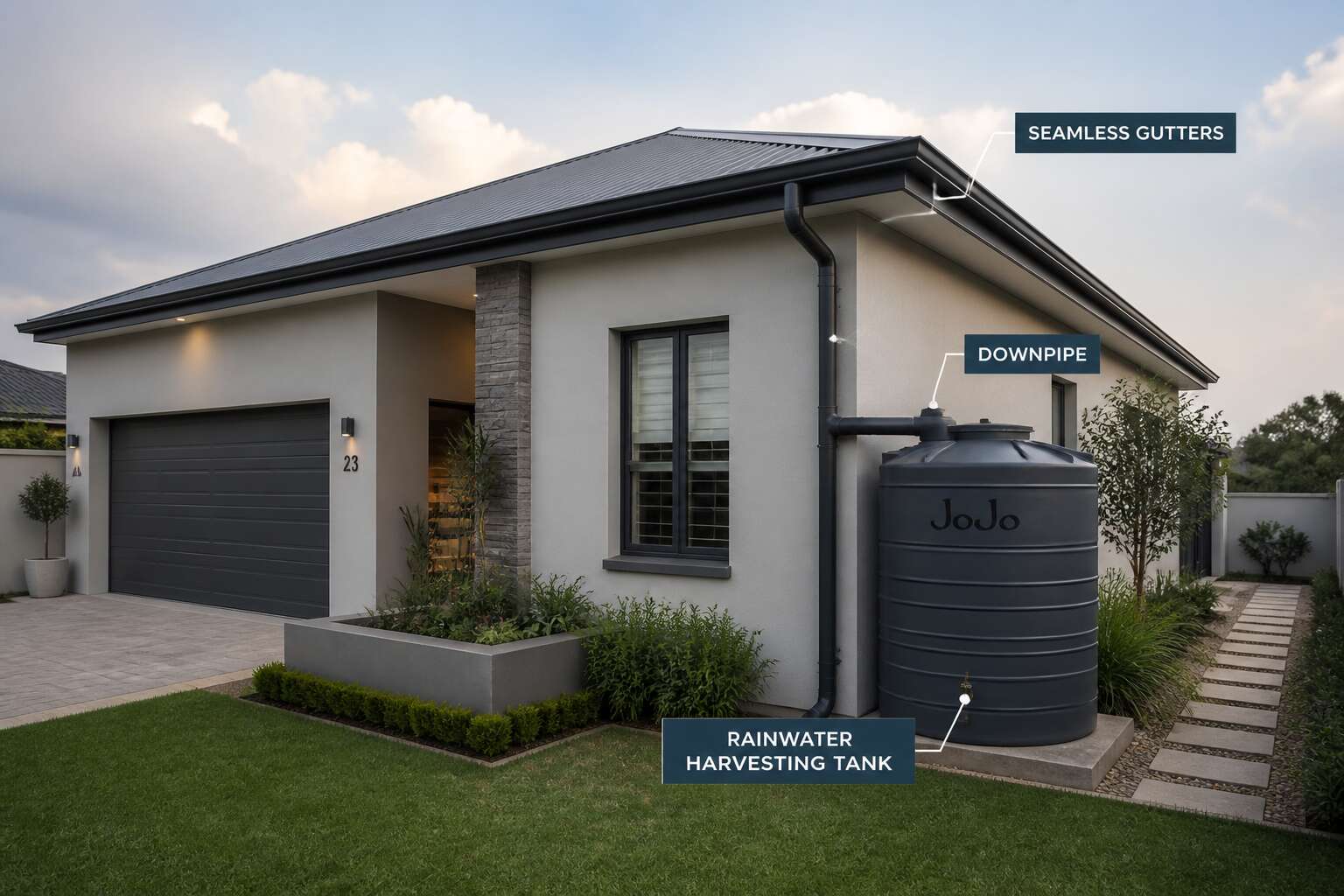
Rainwater harvesting for Gauteng homes only works when the overflow is managed with equal care. A well-integrated system stores what you need then releases the surplus at a safe rate. Proper roof runoff drainage Gauteng includes this dual function.
The design starts with a storage tank. First-flush diverters keep debris out. An overflow pipe routes excess water to a soakaway or attenuation zone. This prevents yard flooding while recharging the water table. Consider these integration points:
- Overflow connections to perforated pipes
- Level sensors for automatic valve control
- Gravity-fed outlets for irrigation
This creates a resilient household water loop that survives both drought and deluge. Sustainability emerges from careful sizing, not from adding extra components.
Permeable Paving and Green Infrastructure Solutions
Hard surfaces on a Gauteng property can double the runoff volume of a natural landscape. Conventional paving turns a residential plot into a sealed surface. Rain that once soaked into the lawn now runs straight to the curb. Permeable paving lets that water pass through to the subsoil, reducing the volume that enters municipal systems. For roof runoff drainage Gauteng, this complements the work of gutters and tanks by handling residual overflow.
Green roofs, rain gardens and vegetated swales add a second layer. They capture the first minutes of a storm, when the highest pollutant load washes off the roof. Bioswales can be planted along boundary lines, while a green roof moderates the temperature of the slab beneath it. Both reduce the peak flow that a downpipe must convey.
The combined effect is a softer water cycle. Less runoff leaves the property, and planted elements recover value from a resource that is often treated as waste. Effective roof runoff drainage Gauteng depends on this layered approach.
Vegetated Swales and Bio-Retention Areas
Gauteng’s summer storms arrive fast. A downpour can send a roof’s worth of water cascading into a yard in minutes. Vegetated swales slow that pulse by guiding runoff along shallow, planted channels. The real work happens underground. A layered mix of sand, compost and indigenous grasses lets water percolate slowly, recharging the local water table. As roof runoff drainage Gauteng becomes more intense, a swale is the first barrier.
Bio-retention areas take this further. These sunken gardens receive overflow from downpipes and hold it for a day or two. Plants absorb moisture while microbes in the root zone degrade pollutants washed off the roof. For roof runoff drainage Gauteng, this creates a buffer between your gutter and the street.
- Spekboom for drought tolerance
- Setaria sphacelata for deep rooting
- Agapanthus for wet conditions
These species tolerate both waterlogging and dry Highveld winters, making them sturdy allies in a climate of extremes.
Cost-Benefit Analysis of Reinforced vs. Standard Systems
A homeowner in Gauteng faces a decision when installing drainage: choose the cheaper standard system, or invest in reinforced components. The difference is not trivial. A standard PVC pipe might cost a fraction of a heavy-duty equivalent, but the potential for failure in this region is high. Dolomitic ground shifts, and clay soils expand and contract with the seasons.
The economics become clear when you consider the cost of a single failure. A collapsed pipe under a paved driveway means demolition, excavation, and replacement. The expense of that repair often dwarfs the initial savings on materials. For roof runoff drainage Gauteng, the ground conditions demand a serious look at what lies beneath.
1. Standard pipes cost less upfront but may deform under heavy backfill.
2. Reinforced concrete or double-wall pipes handle load better.
3. Proper bedding material for either option is a non-negotiable expense.
The real cost consideration is the lifecycle of the system. A reinforced system, installed properly, will outlive the standard alternative by decades. The upfront premium is a form of insurance against the unpredictable nature of Highveld storms and the soil they saturate. When you weigh the potential for sinkholes and washouts, the choice becomes less about immediate budget and more about long-term financial sense.
Weighing the options for roof runoff drainage Gauteng, the reinforced path often proves the more economical route. The buried infrastructure is the hardest part to fix, so spending more on what you cannot see is a prudent strategy. A cheap system is only cheap until it fails.
Seasonal Maintenance Schedules to Prevent Emergencies
Autumn in Gauteng brings a shift in weather. The leaves fall rapidly and thickly, and my downpipes have frustrated me enough times to know that waiting until spring is risky. A schedule for roof runoff drainage Gauteng is not about perfection; it is about catching issues before they become costly failures.
I have learned to walk around after each heavy storm, checking the visible outlets. The dry months offer a chance to inspect for settling or misalignment, but the real test comes with summer rains. A seasonal rhythm, attuned to the Highveld’s extremes, keeps the roof runoff drainage Gauteng system resilient.
- Winter: check for root intrusion and cracks
- Spring: flush pipes after heavy winter use
- Summer: monitor flow during downpours
- Autumn: clear debris from all entry points
Without this cadence, unpredictability of Gauteng’s weather becomes a liability. An emergency arrives after a decade of neglect, not from a single storm.




0 Comments